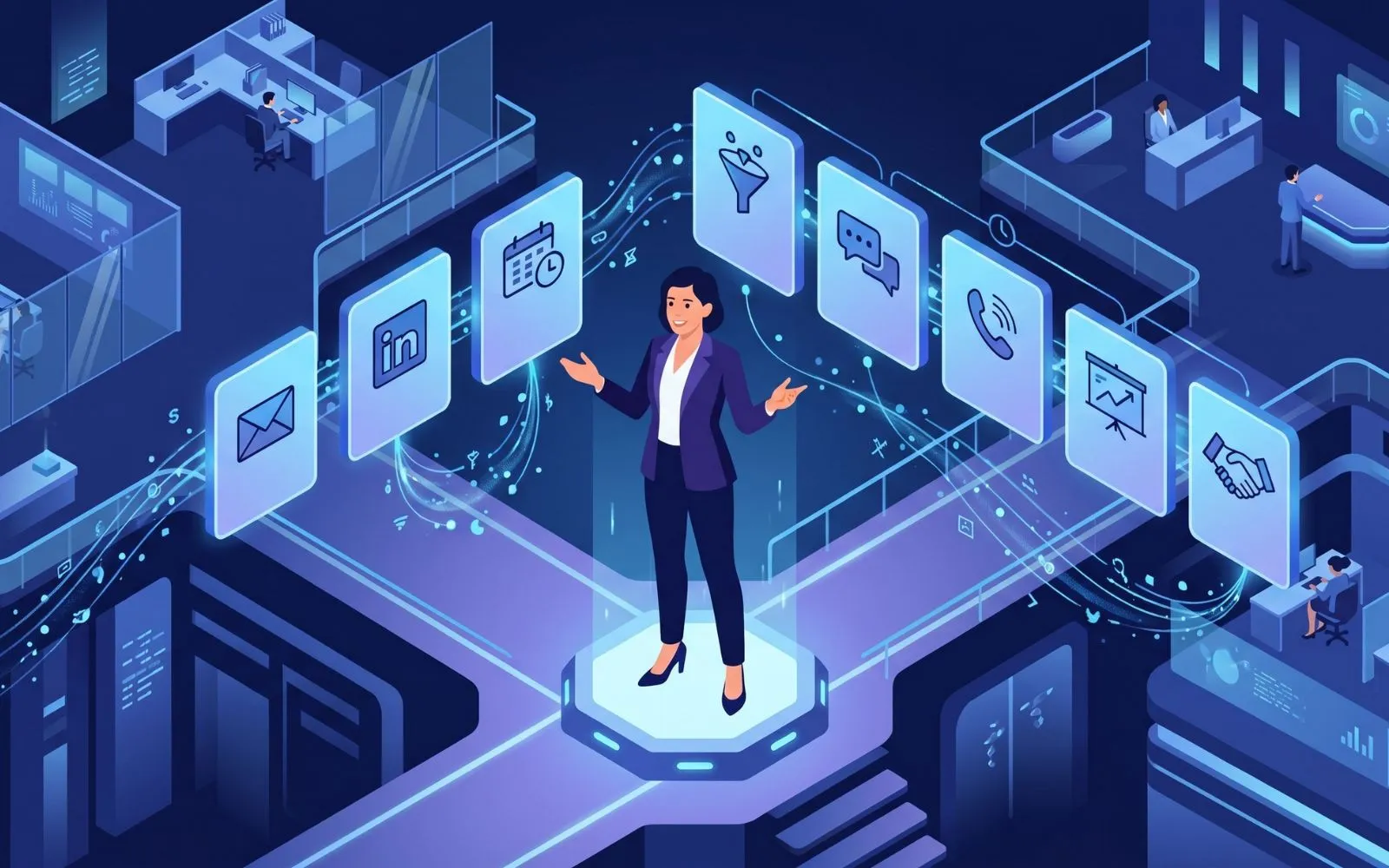
7 Proven Lead Generation Strategies for Consultants
Lead Generation
7 Proven Lead Generation Strategies for Consultants in 2026
Most consultants have the same problem: excellent at the work, terrible at getting more of it.
You close a project. You deliver exceptional results. Then you come up for air and realise the pipeline is empty, the next engagement is not confirmed, and you have three weeks before the feast becomes a famine.
This is not a capability problem. It is a system problem. And in 2026, the consultants who are growing fastest are not the most talented — they are the ones with the most consistent client acquisition system running alongside their delivery work.
This guide covers the seven lead generation strategies that are actually working for consultants right now, why most of the common advice fails, and how to build something that runs whether you are busy on a project or not.
Why Most Consultant Lead Generation Advice Does Not Work
Before getting into what works, it is worth being honest about what does not.
"Post content on LinkedIn every day" is the advice every marketing consultant gives to every other type of consultant. The reality: consistent LinkedIn content takes 5 to 10 hours per week, delivers results only after 6 to 12 months of sustained effort, and is only effective if you already have an audience. For most consultants, it is a full-time commitment that competes directly with the billable work that pays the bills.
"Ask your existing clients for referrals" is correct in principle and useless in practice. Referrals happen on the client's timeline, not yours. You cannot scale a referral system. You cannot predict when the next one arrives. And when your best client pauses or ends the engagement, the referral source disappears with them.
"Cold call prospects" has declining response rates and is deeply uncomfortable for most consultants who got into consulting specifically to avoid sales. Modern buyers screen unknown numbers and regard unsolicited calls as interruptions rather than opportunities.
The common thread is that these approaches depend on something unpredictable: your clients' goodwill, your audience's growth, or your own willingness to do work you dislike consistently over a long time.
Effective consultant lead generation in 2026 needs to be systematic, consistent, and sustainable enough to run during your busiest delivery months — not just when you have spare time.
The Feast and Famine Cycle: Why It Happens and How to Break It
The feast and famine cycle is the defining challenge for independent consultants and small consulting firms. You land a significant engagement and focus entirely on delivery. Prospecting stops. Networking drops. Content goes quiet. Six weeks later the project wraps and you have nothing in the pipeline.
The cycle is predictable. The cause is structural: delivery work and business development compete for exactly the same resource — your time — and delivery almost always wins because it has a deadline attached.
Breaking the cycle requires decoupling business development from your available time. The only way to do this permanently is to build a system that runs without your active involvement, or to delegate the prospecting function entirely.
This is the central argument for managed outbound for consultants — not as a luxury, but as the structural fix to a structural problem.
Strategy 1: Outbound Email to Your Ideal Client Profile
Cold email remains one of the highest-ROI lead generation channels for consultants when it is done correctly. The key phrase is "done correctly" — because poorly executed cold email damages your reputation and produces nothing.
What works in 2026 is hyper-specific outreach: emails written for a single job title at a specific type of company that references a problem you know they are experiencing. Not generic value propositions. Not feature lists. One specific problem, addressed to one specific person, with a single low-friction ask.
What you need to make this work:
- A clearly defined ideal client profile: company size, industry, geography, job title, specific pain
- Verified prospect lists from tools like Apollo, Clay, or LinkedIn Sales Navigator
- Warmed email infrastructure: dedicated sending domains, multi-inbox setup, full SPF/DKIM/DMARC authentication
- A sequence of 4 to 6 emails sent over 2 to 3 weeks with different angles
- A response management process so positive replies do not fall through the gaps
The infrastructure setup alone takes 40 to 60 hours if you are doing it yourself. This is why many consultants either skip cold email entirely or use a managed service to handle the infrastructure, copy, and sending on their behalf.
DeliMail handles the cold email infrastructure side — warmed domains, sending limits, deliverability monitoring — so consultants can benefit from outbound email without spending weeks on technical setup.
Strategy 2: LinkedIn Outreach (The Right Way)
LinkedIn is where your buyers spend significant time. For B2B consultants, it is the highest-concentration channel for reaching decision-makers — CFOs, managing directors, heads of strategy, operations leaders — in a context where they are already thinking about business.
The mistake most consultants make is treating LinkedIn as a broadcast channel (posting content) rather than a one-to-one prospecting channel. Connection requests followed by personalised messages, referencing a specific aspect of the prospect's company or role, consistently outperform content marketing for direct pipeline generation.
What works on LinkedIn for consultants:
- Connection requests to first and second-degree connections in your target vertical
- Message sequences that reference something specific about the prospect's business
- Engagement with prospects' content before reaching out (warms the relationship)
- Following up on profile visits and connection acceptances promptly
The constraint is LinkedIn's weekly outreach limits. Manual LinkedIn prospecting caps out at around 50 to 100 meaningful conversations per week. DeliReach runs LinkedIn outreach at scale across multiple accounts simultaneously, removing the volume ceiling while maintaining the personalised approach that makes LinkedIn outreach effective.
Strategy 3: A Systemised Referral Programme
Referrals are not a strategy on their own — they are an outcome. But you can engineer the conditions that make referrals more likely and more frequent.
How to systematise referrals as a consultant:
- Ask at the right moment: immediately after a project milestone or at the end of a successful engagement, not randomly
- Make it specific: "Do you know any other operations directors at companies your size who are dealing with X?" is more actionable than "Would you recommend me to anyone?"
- Create a reason for past clients to stay in contact: a newsletter, a quarterly check-in call, or a relevant article shared when it relates to their business
- Track referral sources in your CRM so you know which relationships are generating the most introductions
The limitation is still timing and volume. You cannot control when referrals arrive. A systemised referral approach supplements your outbound — it does not replace it.
Strategy 4: Outbound for Consulting Firms — The Managed Approach
For consulting firms of two or more people, or for solo consultants whose hourly rate makes DIY prospecting economically irrational, managed outbound is the highest-leverage option available in 2026.
Managed outbound for consultants means a third party handles the entire top-of-funnel operation: ICP definition, prospect list building, email and LinkedIn outreach, response handling, and meeting booking. You do not touch the campaigns. You attend the qualified meetings.
This is what Deligatr's lead generation service for consultants delivers. The economics make sense when your average engagement value is £5,000 or above — because a single new client typically covers multiple months of the service cost.
The GSC data we see consistently shows consultants searching for "lead generation services for consulting firms," "outsourced lead generation for consultants," and "high ticket lead generation services for consultants" — all of which point toward the same insight: consultants increasingly understand that doing their own prospecting is not the highest use of their time.
Strategy 5: Content Marketing With a Pipeline Focus
Content marketing works for consultants — but only when it is built around buyer intent, not personal branding.
The distinction matters. Most consultants write content about what they know and find interesting. Effective content marketing for pipeline generation is written around the questions your prospects are actively searching for answers to.
High-intent content topics for consultants:
- "How to [solve specific problem your clients face]"
- "[Industry] benchmarks and what they mean for [target company type]"
- "How we helped [client type] achieve [specific outcome]" — case study format
- "[Common misconception in your specialism] and what to do instead"
The goal is not to build a following. The goal is to rank for searches your prospects make when they are actively looking for help — and to be the answer they find.
Internal link note: If your consulting specialism overlaps with financial services clients, the lead generation guide for financial services covers the specific outbound approaches working for accountants, IFAs, and advisory firms in 2026.
Strategy 6: Speaking, Events, and Niche Communities
For high-ticket consulting engagements, trust is a prerequisite. Speaking at industry events, contributing to niche publications, and participating in communities where your buyers spend time builds the credibility that makes outbound conversations easier to convert.
This is a slow-burn strategy that compounds over time. A keynote at a well-attended industry conference can generate more pipeline in a day than a month of cold email — but you have to build the reputation that earns the invitation first.
How to accelerate this:
- Identify the three or four conferences or events your ideal clients attend, not the ones your peers attend
- Pitch a specific, opinionated talk topic rather than a generic "how I do what I do" presentation
- Write for the publications your buyers read, not the publications your competitors read
- Join and genuinely participate in two or three niche communities before trying to extract value from them
Strategy 7: QualiPi as a Lead Qualification Tool
For consultants who work with other business owners, the QualiPi free business health assessment is worth knowing about as both a tool for your own firm and as something you can share with your clients.
QualiPi scores businesses out of 45 across five areas: revenue predictability, client acquisition, cash flow, operations, and strategy. The 3-minute assessment generates a personalised AI report that identifies the biggest gaps and recommends the most relevant next steps.
For consultants prospecting for new business: sharing QualiPi with a prospect before a discovery call gives you a data-rich brief on exactly where they are struggling — which makes your initial conversation significantly more targeted and valuable.
For consultants evaluating their own firm: the report tells you whether your client acquisition system is genuinely the bottleneck, or whether operations or strategy gaps are holding back growth first.
Building a Lead Generation System That Survives a Busy Quarter
The single most important principle in consultant lead generation is this: your system has to work during your busiest months, not just when you have spare time.
A LinkedIn content strategy that requires 10 hours per week is not a system — it is a good intention that will be abandoned the moment you are 80% utilised on client work. A cold email campaign you have to write and manage yourself is not a system — it is a task that competes with billable hours.
A genuine lead generation system for a consultant has three characteristics:
1. It runs without your active involvement. Either it is automated, or it is delegated. If it requires your daily attention, it will fail during your next busy period.
2. It targets the right people. Not broad audiences, but the specific job titles and company profiles that match your ideal engagement. Spray-and-pray outreach is noise. Targeted outreach to a well-defined ICP is a conversation.
3. It delivers qualified conversations, not just leads. The output of your lead generation system should be booked calls with decision-makers who have a relevant problem you can solve — not enquiries you have to qualify yourself before investing time.
How Consultants Are Using Deligatr in 2026
The consultants getting the best results from Deligatr's managed AI outbound service share a common profile: they have a clearly defined specialism, a proven track record with a specific client type, and engagements valued at £5,000 or above.
The process is straightforward. One ICP workshop at the start — typically one hour — where we define the ideal client profile, the problem narrative, and the positioning. Then we handle everything: prospect research, email infrastructure, copywriting, outreach, response qualification, and meeting booking. The consultant receives qualified calls in their calendar.
For consultants not yet ready for fully managed outbound, DeliSolo is the done-with-you alternative: we build the complete system — CRM, cold email, LinkedIn outreach — configured for your specific consulting vertical, then hand it to you to run with concierge support available.
Frequently Asked Questions
How do consultants generate leads without cold calling?
Cold email and LinkedIn outreach are the two highest-performing alternatives to cold calling for B2B consultants. Both allow you to reach decision-makers at scale without requiring real-time phone conversations. The key is personalisation — messages that reference a specific aspect of the prospect's business consistently outperform generic templates by 3 to 4 times on reply rate.
What is the best lead generation strategy for independent consultants?
For independent consultants, the best strategy is the one that runs consistently alongside delivery work. A fully managed outbound service — where a third party handles prospecting, outreach, and meeting booking — is the most reliable option for consultants whose billable hours leave limited time for business development. For those who prefer to run their own campaigns, a properly configured email and LinkedIn system with pre-built sequences is a close second.
How long does it take to see results from consultant lead generation?
Cold email and LinkedIn outreach typically produce first conversations within two to three weeks of launching. Meaningful pipeline — multiple qualified meetings per month — usually stabilises by month two as campaigns are optimised based on initial response data. Content marketing and referral systems take three to six months to show consistent results.
How much does lead generation for consultants cost?
DIY tools (email platforms, LinkedIn automation, data) cost £300 to £800 per month plus significant time investment. Done-with-you services like DeliSolo cover the full system build for a one-time setup fee. Fully managed services like Deligatr's start below the fully loaded cost of a part-time SDR and include all infrastructure, copywriting, and campaign management.
What is the difference between lead generation for consultants and lead generation for agencies?
The core mechanics are similar — outbound email and LinkedIn targeting decision-makers at ideal client companies. The differences are in ICP definition (consulting engagements typically target more senior buyers), sales cycle length (consulting often has a longer trust-building phase), and value proposition (consulting is sold on expertise and track record rather than on product features). See the lead generation for agencies guide for agency-specific approaches.
Can consultants use QualiPi with their own clients?
Yes. Many consultants and accountants share QualiPi with their business owner clients as a free diagnostic tool. The 3-minute assessment generates a personalised business health report that can start a productive advisory conversation without the consultant having to run a lengthy discovery process first.
The Bottom Line
Lead generation for consultants is not a mystery. It is a system problem disguised as a skills problem.
The consultants who have consistent pipelines in 2026 are not better at sales than their peers. They have a system that runs when they are busy, not just when they have spare time. They are reaching the right people with the right message consistently — whether that system is running itself, is being managed externally, or was built by a specialist and handed back to them.
If you want to know where your consulting firm has the biggest gaps right now — whether lead generation is genuinely the bottleneck or something else is holding back growth — the free QualiPi business health assessment takes 3 minutes and tells you exactly where you stand.
Or if you are ready to build the system, book a free strategy call — we walk through your ICP, your current pipeline, and give you a clear recommendation before you commit to anything.
Recent Blog
Financial Services
How Financial Advisers Get New Clients in 2026 (No Referrals)
Stop depending on referrals. The complete guide to compliant outbound marketing for IFAs, mortgage b...
Sales Strategies
How Consultants Run Outbound Without Hiring an Agency
Most consultants depend on referrals until they dry up. Running your own outbound is the fix — but o...

Sales Outreach Insights
Done For You vs Done With You Outbound in 2026
These two models sound similar but describe completely different realities. Choose wrong and you ove...